
• Home
  • Helpful Resources
  • Reading List
  • Recommended Blogs
  • Marilyn’s Legacy: A World Without Alzheimer’s
  • About Me
  • Contact Me

The Long and Winding Road…

~ An Alzheimer's Journey and Beyond

The Long and Winding Road…

Category Archives: Behaviors

Music For Your Loved One

18 Saturday Jan 2014

Posted by Ann Napoletan in Behaviors, Caregivers, Giveaways, Mom, Music and Art, Products, Smiles, Tips, Treatments and Therapies

≈ 15 Comments

Tags

alzheimers, caregiving, dementia, music for alzheimers, music therapy

The winner is … Mary!

CD winner


old-radio
We’ve seen plenty of evidence that music can create magical moments for Alzheimer’s and dementia patients. It has the power to reduce depression and agitation, improve cognitive function, and provide wonderful opportunities for interaction with caregivers and loved ones. Music was certainly comforting to my mom, even in the very late stages of the disease.

One of the most compelling examples is illustrated in a YouTube video that went viral shortly after its 2012 release. “Henry” had been battling dementia for years, becoming completely withdrawn and non-communicative.  And then, the magic happened; caregivers played some of his favorite songs from years gone by, and he suddenly came to life.  The man who had previously barely spoken was now singing Cab Calloway’s hits and reminiscing about how much he loved music and dancing when he was young. It was nothing short of a miracle.

The past, which is not recoverable in any other way, is embedded, as if in amber, in the music and people can regain a sense of identity…  -Oliver Sacks, MD

Knowing firsthand how powerful music can be, Audrey Greene decided to combine her musical gift with years of eldercare experience to create a CD; however, she needed funding to make it happen. With that in mind, she began a Kickstarter campaign and with the help of 105 backers, raised over $4,700 to offset licensing and production costs.

During the crowd funding process, Audrey said, “At 57, I’m learning once again that almost anything is possible.” Indeed, this past November she realized her dream when “Mom’s Musical Memories” was released.

The CD contains 15 tracks, all carefully chosen for their potential to unlock memories, encourage reminiscing, and create musical moments of joy. Songs include old favorites like You Are My Sunshine, Somewhere Over the Rainbow, Let Me Call You Sweetheart, When the Saints Go Marching In, and Take Me Out to the Ballgame.

…Science aside; when an elder who’s been closed off and uncommunicative lifts her head, smiles, and begins to sing along, the power of music cannot be denied.  –Audrey Greene

The American Music Therapy Association says music not only encourages positive changes in mental status, but it can even be beneficial in pain management. Music also provides a wonderful opportunity for social interaction and reminiscence.

Research shows music touches areas of the brain that may not be damaged by the disease. In doing so, it brings those healthy pathways to the forefront. The result can be an astounding “awakening” like that experienced by “Henry” when he listened to songs from his era.

You can find Audrey’s CD on iTunes, Amazon, and Google Play, and she has graciously offered a copy to one lucky reader. To enter for a chance to win the CD, just leave a comment on this post. I’ll select a random winner on Saturday, January 25th. Good luck!


Audrey Greene has 20 years experience working at nursing facilities throughout Rhode Island. Her biggest musical influences are Ella Fitzgerald and Frank Sinatra, but she enjoys a wide variety of music, “anything from James Brown to Mozart.” Audrey’s goal is to raise awareness and encourage hope throughout the community with music. You can visit her website or find her on Facebook, and she can be reached via email at audreyjgreene@yahoo.com.

Share this:

  • Click to share on X (Opens in new window) X
  • Click to share on Facebook (Opens in new window) Facebook
  • Click to share on Pinterest (Opens in new window) Pinterest
  • Click to share on Reddit (Opens in new window) Reddit
  • Click to share on LinkedIn (Opens in new window) LinkedIn
  • Click to share on Tumblr (Opens in new window) Tumblr
  • Click to email a link to a friend (Opens in new window) Email
Like Loading...

Sensible Strategies for Coping with Sundowner’s

10 Sunday Nov 2013

Posted by Ann Napoletan in Behaviors, Caregivers, Helpful Resources, Signs and Symptoms, Sundowning, Tips

≈ 2 Comments

Tags

alzheimers, caregiving, dementia, dementia behaviors, sundowners, sundowning

clockThat pesky biannual time change wreaks havoc on all of us – it never ceases to amaze me how much one little hour can throw my body clock into a tizzy.

Anything that rough on us has to be exponentially more difficult for those living with dementia. The autumn change seems particularly challenging since it means the sun is setting so much earlier.

Sundowner’s

Sundowning is a term commonly used to describe a marked increase in confusion and agitation in dementia patients as evening approaches. Experts have long debated exactly what causes this phenomenon, but no one has a definitive answer.

Many believe the decrease in light is a big part of the equation, while others feel Sundowner’s may be due to hormonal changes occurring at night or even just simple fatigue. There are also those who think the symptoms could be caused by an accumulation of sensory stimulation from the day, causing an “overload” of sorts and resulting in stress and anxiety.

Six Ways to be Proactive

  • sunny-autumn-dayIdentify triggers. Limit outings, visits and other highly stimulating activities to morning or afternoon. Keep noise and commotion to a minimum in the evening; turn off the television and consider playing soft music instead.

  • Avoid afternoon naps. Too much sleep during daylight hours can confuse the body’s circadian rhythms. Plan daytime activities and encourage light exercise to help expend excess energy in a healthy way.
  • Watch their diet. Limit sweets and caffeine to morning hours. Some people also do better having their heaviest meal at lunchtime and opting for a light dinner.
  • Maintain a consistent routine. Dementia patients do best when kept on a schedule. Routine and structure go hand in hand with a feeling of safety and security. Keep meals, showers, bedtime, and wake time as consistent as possible.
  • Be cognizant of the environment. Clear excess clutter, which can contribute to the agitation caused by sundowning. Consider the fact that even seemingly benign objects like mirrors and photographs can frighten or confuse someone with dementia. Before dusk falls, close curtains and blinds and turn on as many interior lights as possible.
  • Ensure their physical comfort. Hunger, thirst, and pain will increase anxiety and fruitagitation. Offer a light healthy snack and be sure they’re hydrated without overdoing liquids close to bedtime. See that they are dry, and keep the room/house at a comfortable temperature. A sudden spike in agitation could also indicate the presence of a urinary tract infection or another ailment.

 Tactics for When All Else Fails

It’s important to know that despite the best laid plans, sometimes there’s simply no avoiding it. It’s a fact – staving off Sundowner’s is one part art and one (or more) part luck. There are a few things that may help, though.

  • Redirect. If you notice increased activity or pacing in your loved one during evening elderly-womanhours, attempt to redirect them to quiet activities such as working puzzles, folding washcloths, or listening to music. If they insist on pacing, allow them to safely do so; never try to physically restrain them.

  • Provide reassurance. Speak in a soft, soothing tone letting them know that everything is okay. Avoid arguing – it will only make things (much) worse.
  • Touch does wonders. A gentle massage or backrub, or even just sitting and holding his or her hand, can bring a sense of calm.
  • Do your best to keep your cool. Patience can be in short supply at times like this, but remember your loved one will sense your stress, which often adds to their agitation.
  •  Seek help. It may help to keep a journal for a couple of weeks to try and identify patterns. If sundowning becomes increasingly problematic, discuss your concerns with the doctor. Medication may be considered as a last resort.

Maintaining Perspective

autumn-colorWhen frustration is getting the best of you (and if you’re human, it will), try to remember they are not acting out intentionally. Don’t take their words or actions personally.
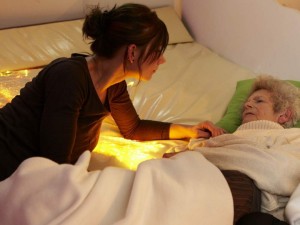
The most important thing is keeping them safe; beyond that, it’s often best to follow their lead. Sometimes my mom didn’t want anyone talking to her but appreciated holding hands; at other times, she just wanted to be left alone to pace. And to be quite honest, there were moments where there was just no consoling her – those were the most difficult. A feeling of helplessness like nothing I’ve ever experienced.

It all comes part and parcel with the disease and all we can do is our best – whatever that is at the moment.

How have you dealt with sundowner’s? Can you offer any advice to other caregivers? If so, leave a comment. I’d love to hear from you!

Share this:

  • Click to share on X (Opens in new window) X
  • Click to share on Facebook (Opens in new window) Facebook
  • Click to share on Pinterest (Opens in new window) Pinterest
  • Click to share on Reddit (Opens in new window) Reddit
  • Click to share on LinkedIn (Opens in new window) LinkedIn
  • Click to share on Tumblr (Opens in new window) Tumblr
  • Click to email a link to a friend (Opens in new window) Email
Like Loading...

The What, Why, and How of Snoezelen Therapy

26 Thursday Sep 2013

Posted by Ann Napoletan in Behaviors, Helpful Resources, Mom, Music and Art, Pharma, Ruminations, Treatments and Therapies

≈ 2 Comments

Tags

alzheimer's therapy, alzheimers, dementia, multi-sensory environments, snoezelen

Snoezelen RoomFor some reason, when I see the word Snoezelen, I think one of my favorite Sesame Street characters, the adorable Mr. Snuffleupagus. Of course, the two aren’t even remotely related, but for some reason I can’t get the image of that adorable woolly mammoth out of my head!

Why Snoezelen?

The term itself is derived from the Dutch words “snuffelen” (sniffing) and “doezelen” (dozing). Snoezelen originated in the Netherlands as a way compensate for sensory deprivation in the profoundly disabled. One study suggests that the average healthy person touches up to 300 different surfaces every 30 minutes, whereas a person with a severe disability will often touch less than ten surfaces in the same amount of time.

In the 1960’s and 1970’s, researchers found that in the absence of adequate stimulation, the brain begins to hallucinate to make up for what’s missing. Subsequent studies, including one led by Dr. Jason A. Staal, at Beth Israel Medical Center in NYC, have proven that augmenting the environment with various sensory stimuli can actually reduce agitation, depression, and apathy in patients.

How Does It Work?

Snoezelen RoomIn Snoezelen therapy, multi-sensory environments are created using visual, auditory, tactile, and aromatherapy stimulation. The concept has been successful with people of all ages, and in this safe, comfortable setting, Alzheimer’s and dementia patients have found peace and solace. The “treatment” can elicit calmness, an overall feeling of wellbeing, and a sense of security. In some cases, memories are awakened through the process.

Depending on how they are used, light, sound, and scents can evoke a variety of responses, and there is a risk of overstimulation. For this reason, when creating a “Snoezelen room,” it’s important to tailor the setting to each individual’s unique needs. Ideally, patients should be presented with a variety of options and have the freedom to choose the sensory experiences they find most pleasing.

Case Study

In a 2011 interview, Angela Green of Christian Care Centers in Mesquite, Texas, discussed the success they’ve had with Snoezelen rooms in their Alzheimer’s/Memory Care unit.

“The agitated individual that’s not able to communicate verbally [and] that has a lot of frustration from the stimulation they’re receiving will go into the Snoezelen room and find peace and to relax and enjoyment… We found that the colors and the sound and the motion and the touch that they’re able to experience, all of those things involve all of their senses and give them a complete enjoyment of their surroundings and something to interact with. It’s not uncommon to see one laughing or dancing when they’re in the environment, and even having good memory recall to the point that they can answer questions.”

Snoezelen RoomSnoezelen and Alzheimer’s

I don’t know about you, but this is something I would have jumped at the opportunity to try with my mom. The obvious question: Why aren’t we hearing more about alternative treatments like this here in the United States? We all agree that research is critical, but we also owe the best quality of life possible to those who are living with Alzheimer’s right now, don’t we??

I could rattle off the litany drugs that Mom’s neurologist prescribed during the course of her illness – everything from citalopram for depression to heavy-duty psych drugs like Risperidone, Divalproex (Depakote), Olanzapine (Zyprexa), and Lorazepam (Ativan)… and the list goes on.

The last couple of years, the psychotropic drugs rarely eased her agony and terror. I have to wonder if something like Snoezelen therapy could have helped to calm and relax her during those horrible spells. Mom is gone now, so I’ll never know – but it’s certainly something other families should have the option of considering…

For more information on Snoezelen and Multi-Sensory Environments, consider visiting these sites:

  • American Association of Multi-Sensory Environments
  • International Snoezelen Association
  • Stepping Stones
  • WorldWideSnoezelen.com

Photo credit: WorldWideSnoezelen.com

Share this:

  • Click to share on X (Opens in new window) X
  • Click to share on Facebook (Opens in new window) Facebook
  • Click to share on Pinterest (Opens in new window) Pinterest
  • Click to share on Reddit (Opens in new window) Reddit
  • Click to share on LinkedIn (Opens in new window) LinkedIn
  • Click to share on Tumblr (Opens in new window) Tumblr
  • Click to email a link to a friend (Opens in new window) Email
Like Loading...
← Older posts
Newer posts →
© Copyright 2025
All Rights Reserved
The Long and Winding Road

Marilyn, BA (before Alzheimer's)

Contributor

Contributor

Recent Posts

  • The Latest Alzheimer’s Research Developments
  • National Caregivers’ Day: February 21, 2025
  • June 7, 2021: A Historic Day
  • UsAgainstAlzheimer’s National Alzheimer’s Summit: Don’t Miss It!
  • Happy 84th Birthday, Mom.

Enter your email address to follow this blog and receive notifications of new posts by email.

Join 444 other subscribers

Archives

Blog Directory & Business Pages at OnToplist.com

Blog Stats

  • 138,557 hits

Meta

  • Create account
  • Log in
  • Entries feed
  • Comments feed
  • WordPress.com
stats for wordpress

Categories

Popular Posts

  • About Me
  • Thank you!
  • A Special Bond
  • Monday ... on Caregivers
  • Telling the Story
  • Hiding In the Canned Goods Aisle...and Other Stuff
  • Walking a mile in his shoes...
  • CGSN: Focus on YOU!
  • Look for me on VoiceQuilt!
  • Caregiving: Imperfections, Weaknesses, Acceptance, and Forgiveness

Recent Comments

  • Motherhood: Lost and Found, a Memoir of a Mother’s Alzheimer’s | The Long and Winding Road… (alzjourney.com) | Ann Campanella on Motherhood: Lost and Found, a Memoir of a Mother’s Alzheimer’s
  • Betty Trimble on Film Review: Angel’s Perch
  • Carol on Caregiver PTSD: Fact or Fiction?
  • (3) Ritamae Reichardt on When Caring Takes Courage: A MUST HAVE Caregiving Guide
  • Mary Jo George on June 7, 2021: A Historic Day

Pages

  • 2013-2014 News Archive
  • Helpful Resources
  • Latest News & Events
  • Postmaster General Letter – Alzheimer’s Semipostal
  • R E S I S T Resources
  • Reading List
  • Recommended Blogs
  • About Me
  • Contact Me
Coming Soon!
Marilyn's Legacy: A World Without Alzheimer's, Inc.
Stay tuned!!

Blog at WordPress.com.

  • Subscribe Subscribed
    • The Long and Winding Road...
    • Join 444 other subscribers
    • Already have a WordPress.com account? Log in now.
    • The Long and Winding Road...
    • Subscribe Subscribed
    • Sign up
    • Log in
    • Report this content
    • View site in Reader
    • Manage subscriptions
    • Collapse this bar
 

Loading Comments...
 

    %d