I’m pleased to post the following article courtesy of Michael Ellenbogen. Michael is a former IT executive diagnosed with younger onset Alzheimer’s at age 49. As a leading advocate, he courageously shares his story in an effort to raise awareness, and recently authored the book, From the Corner Office to Alzheimer’s.
Earlier today, Michael participated in a panel discussion on Alzheimer’s Speaks Radio. Life or Death with Dementia: The Taboo Conversation tackles an extremely sensitive topic – should someone have the right to decide when they want to end their life? Click here to watch.
______
Living with Alzheimer’s
by Michael Ellenbogen
Imagine if you will, waking up one morning and going about your daily business, you have had breakfast and are about to leave for work, but you can’t remember where you left your keys. Common enough you say; we have all done that at some time or other. Your wife hands you your keys and off you go.
Life carries on as normal for a few weeks then one day, while at work you have to call a colleague, but you have inexplicably forgotten his extension number; an extension number you have called numerous times a day for the past 10 years. You feel silly but put it down to being tired. You work hard and hold a high profile position in a financial institution so it is understandable that you will have memory lapses now and again. Like the key incident, you laugh it off.
More Than Just a Memory Lapse
Over the next few months things start to get worse, you are forgetting people’s names even though you have worked with them for many years, you are making stupid mistakes at work, you are forgetting to go to meetings, you are finding it really difficult to do the simplest of tasks, you continually forget where you parked the car. Again you are told by friends and colleagues and doctors that it is down to stress; that you need to slow down, maybe take time off etc. But you know there is something wrong, you know that it is more than stress.
So you start keeping a record as best you can and you pester your doctor for answers. One day you get the answer. An answer no one expected.
An answer that will change your and your family’s life forever.
You have Younger Onset Alzheimer’s Disease.
There Are No Survivors
Alzheimer’s is an incurable, progressive loss of brain cells. In the beginning it targets the memory and speech, as time goes on the symptoms become wider ranging and debilitating and include disorientation, difficulty judging distances, poor vision, poor speech/writing abilities, repetitive behaviour, mood swings, and depression.
Then in the final stages of the disease it is not just the mind that is affected; the body is rapidly declining also. In the late stages of Alzheimer’s there will be difficulty swallowing, a needed for assistance when changing position or moving from place to place, there is increased vulnerability to infection and a complete loss of short-term and long-term memory. Death is slow, painful, undignified, and inevitable.
My name is Michael Ellenbogen and this is my diagnosis.
Raising Awareness

For the last decade I have campaigned on behalf of myself and all those suffering from this devastating disease. Why do I have to campaign? I do it because over five million Americans have Alzheimer’s, and other forms of dementia. And what is more shocking is the lack of knowledge out there about this illness.
I have become extremely surprised by the lack of public commitment to my pleas for support of Alzheimer’s disease. While some may be sympathetic in the moment, there appears to be little follow-through.
People look at me and think there is nothing wrong; I am not in a wheelchair, I have full use of all my limbs, I can see, hear, speak and listen…… but not for much longer.
I am dying; day by day hour by hour my life is ending.
Coping With Daily Changes
So much of my life has changed with this disease; household chores that were once second-nature, like cutting the grass have become frustrating difficult and for me to perform. I leave things lying around the house; not to be difficult, but because I have forgotten where they go, and I am also afraid that if they do get put away I will not remember where they were put.
I was once a very sociable person but now I go to a happy affair only to be tortured by the noise and surrounding conversations because I am overwhelmed by the stimulus of sight and sound. I don’t understand what people are saying; the words run together and they may as well be speaking a foreign language.
I can no longer write or speak like I used to, what you a reading now has been written by a friend of mine who helps me put my words onto paper. My friends have become distant and even when in their presence they will address my wife, even when enquiring after me they rarely direct their questions to me. This is heart-breaking for me, the fact that they feel they can no longer talk to me really saddens me.
Frustration Ensues
Grocery shopping with my wife is time consuming and frustrating as I find it difficult to make decisions and plan ahead for meals. Eating out was something I used to enjoy but now I am unable to read the menu and assimilate the information into a decision. At home my wife has to assemble my meals in a series of individual decisions.
There was a time when I could follow a map and easily get from point A to B. Now I rely on my wife for navigation, I know that it won’t be long before I can no longer drive and that really upsets me because I love going out for long drives in my car, it is the last vestige of independence I have left.
I used to be smart, I worked hard, and I accomplished a lot. Seeing all my failures today are giving me a new appreciation for the things I was once capable of doing. I was a very different person, but that intelligence still shines through occasionally as I am challenged to invent new coping strategies to respond to these changes.
This disease is costing me money in so many ways because of the problems and issues I create; I have broken gardening tools because I have forgotten how to use them properly.
Growing Challenges
Personal grooming is a problem as well; as I can never remember the last time I washed my hair or changed my clothes.
In meetings I will lose track of the subject matter if the information is shared in long sentences. If I am speaking at events or meeting I must have my speech printed a large font size with clearly marked punctuation.
Sometimes my mind does not communicate with the rest of my body; I had to turn the grate on my fireplace but instead of tentatively feeling if it was hot or not I just picked it up and badly burned my hand.
I can no longer use my video recorder. I had trouble remembering which way to turn off the water in the garage for the hose.
I lost my job because I could no longer function in the environment, so now I spend my days advocating for Alzheimer’s it gives me a reason to get out of bed in the morning, it stimulates what is left of my mind.
The Effect on Loved Ones
Do you know what the worst part of this is? I have to watch my wife struggling to do the things that I once was capable of doing, and know I cannot do anything thing to help. I see my wife becoming stressed, depressed and overwhelmed, and know it will only continue to get worse.
My wife is on the road to hell; I have not even reached the worst stage. That scares the hell out of me.
I am losing my mind and I can see it happening, but I cannot do anything to change the course.
Living… and Dying With Alzheimer’s
I am slowly becoming a child again, and will soon be a body with no mind.
At what point should I give up? At what point would you give up?
What do I have to look forward to?
Why should I put my wife through any more pain and sadness, do I really want her to watch me slowly die in front her eyes?
Any chance I had at a good life and a happy retirement has gone; my life is pretty much over. If you were in my shoes would you want to carry on, knowing what is in store for you?
Freedom to Choose
I want to die on my own terms, I want to die with dignity, I want to die while I can still make the decision to die, and that is a very small window because I know in the not too distant future even that choice is going to be taken from me.
The laws we have in place today do not take into account the needs of people suffering from dementia; we need to rethink not only how we regard people with this disease, but also how we look after them.
We need to have things in place not only to help those suffering live vital and productive lives, but also provide the means necessary for them to die with dignity and at a time of their choosing. We need to take our heads out of the sand; we can no longer turn a blind, this is a very real problem, this is happening now to millions of people across America.
We need your help!
__
A special thanks to Michael Ellenbogen for sharing this article. To learn more about his work, please visit the Michael Ellenbogen Movement.

 November is Alzheimer’s Awareness Month – a great time for everyone to help shine a spotlight on this impending national health crisis. It’s estimated that 5.3 million Americans are currently living with Alzheimer’s, and 4% of those cases qualify as younger onset, attacking people in their 30’s, 40’s, and 50’s.
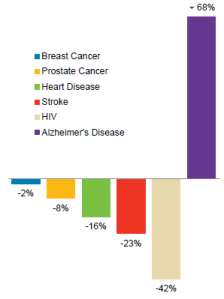 AD is the 6th leading cause of death in the United States (5th among those over age 65). It’s also the only one of the top 10 causes of American deaths that can’t be prevented, cured, or even slowed. Simply put, there are no survivors.
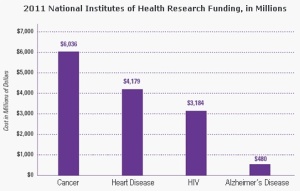 Research funding isn’t where it needs to be – not by a long shot. The National Institutes of Health spends over $6 billion/year on cancer research, over $4 billion/year on heart research, and over $3 billion/year on HIV/AIDS research. Less than $500 million/year is spent on Alzheimer’s – the disease that’s shaping up to be the health crisis of our generation.


 I saw a picture a few days ago, and it’s been on my mind ever since. The image was that of an older woman sitting alone on a bench looking off into the distance. The caption said, “Alzheimer’s isn’t contagious.”


 The Long and Winding Road...