
Amazon GIVES to fight Alzheimer’s
19 Saturday Nov 2016
Posted in Advocacy and Awareness, Fundraising, Marilyn's Legacy
19 Saturday Nov 2016
Posted in Advocacy and Awareness, Fundraising, Marilyn's Legacy
18 Friday Nov 2016
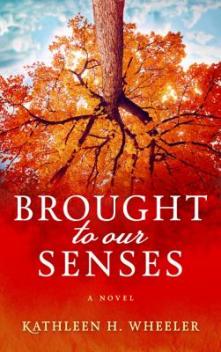
Today, I’m happy to share a guest post from author Kathleen H. Wheeler. Wheeler’s new book, Brought To Our Senses, is a fictional work that explores the importance of family and forgiveness when facing dementia.
The novel tackles the impact a messy divorce has on a family, how Alzheimer’s affects already tenuous relationships, and the excruciating journey to obtaining legal guardianship.
Wheeler writes from her own experience as a young sandwich generation caregiver in the mid 1990’s. These days, she characterizes her life in terms of BA (before Alzheimer’s) and AA (after Alzheimer’s), terms I’ve often used myself. Those of us who have traveled this road know that to say it’s a life-changing experience is an understatement.
Please join me in thanking Kathleen for being with us to share her story.
Why choose Alzheimer’s as the focus of my new family saga novel Brought To Our Senses?
It’s a fair question. After all, Alzheimer’s is argued to be the disease feared most of all. The mind-robbing illness has a bad reputation and a stigma stifling discussion in mixed company. So why exactly would I tackle such a difficult subject, one so many avoid altogether or shrug off as hopeless?
The answer is simple: Alzheimer’s has transformed my life, an existence now measured in two distinct periods of time: BA and AA. “Before Alzheimer’s” was my life until 1996 when dementia came calling for my mother with a vengeance. She was only 62, and I was 30 with a newborn daughter at home. “After Alzheimer’s” is the last twenty years I’ve spent raising two children and dealing with my mother’s diagnosis, decline, and death from this monster.
My mother passed away in 2009 but dementia lingers like the familiar nightmare waking me in a panic and cold sweat. I’ve never faced anything more difficult or devastating in my life. Like it or not, Alzheimer’s has wormed its way into my present and future thanks to genetics. I am susceptible, as are my siblings and children, and this reality drives my waking hours and efforts.
For raising awareness through my story, I was recently recognized as an Alzheimer’s advocate by the Greater Illinois Chapter of the Alzheimer’s Association during the opening ceremony of the Walk to End Alzheimer’s on September 24, 2016. It was a humbling event. So many people work to raise awareness, to change policies and attitudes, to provide support and hope that my efforts seem small by comparison.
 While some see my efforts as selfless, my motives are equally selfish because I advocate on my own behalf and that of my family. With all of our futures at stake, doing nothing is inconceivable. I desperately want a cure for dementia so that my children and their generation will never experience the devastation my siblings and I have witnessed. No one, whether age 85 or 40, should suffer through the tortured course of dementia.
That’s why I wrote Brought To Our Senses, and I had three goals for my book.
1 The Story: First and foremost, I wanted to tell a compelling story, one that just sucks you in from the get go. I’ve been drawn to reading and writing since I was a kid and have always wanted to write a novel. Once I grasped the premise for my book and realized what a great story it was, I just couldn’t let it go. I had to write it.
2 Build Awareness: I wanted to share the reality of the illness, from before a person is afflicted through the bitter end, and I wanted to emphasize the importance of strong family relationships to get through such an ordeal.
3 Give Back: Finally, I wanted to do something positive for the community, something that would help others struggling with the difficulties of dementia. For each copy of my book sold, I’m donating to organizations that support dementia patients, family caregivers, and research to find a cure.
I’m excited to share my book with the world and hope it will provide hope and inspiration to those touched by dementia. I’m never going back to the time “Before Alzheimer’s” and plan to look ahead and work toward a world without Alzheimer’s instead. It’s the ultimate goal for all of us who have lost a loved one to this disease.
About the Author:

Kathleen H. Wheeler, author of the debut novel Brought To Our Senses, writes stories that sing because she cannot. A graduate of the University of Illinois, she has wordsmithed as a marketing communications professional for ad agencies and corporations since Nike first coined the slogan “Just Do It.” Wheeler is a music enthusiast and lifelong fan of a British musician known by a one-syllable nickname. Along with her husband and two children, she calls the Land of Lincoln home.
Look for Kathleen on Twitter and Facebook, and be sure to check out her blog!
Elizabeth Miller discovers that aging parents are a family affair when her divorced mother receives a deadly diagnosis and becomes a volatile patient. Forced to work with siblings at odds through the crisis, she learns when all is lost, family begs to be found.
Brought To Our Senses (Attunement Publishing, released November 1, 2016, paperback $16, ebook $9.99) is available now from all major online retailers. For more information, visit www.BroughtToOurSenses.com.
10 Thursday Nov 2016

Ann Campanella with her mother
Today I’m very happy to share a guest post from award-winning author and blogger, Ann Campanella.
As Ann and I exchanged a few initial emails, I felt an immediate kinship with her. Alzheimer’s is life changing. For me, that manifested itself in a strong desire to use my experience for good – to help others. I’ve always said that I need to know this journey was not in vain and that our story has purpose. Ann shares that sentiment.
“Like you I’m passionate about reaching out to those who need support in their journey through Alzheimer’s,” she said. “My mother lived with the disease for almost a decade and a half, and, at the time, I felt very alone. That’s part of the reason I hope to share my story…to give others an emotional road map through this kind of difficult life circumstance.”
Please join me in thanking Ann for sharing her uniquely beautiful story with the world.
_____
My mother was a kind and gentle soul who loved words. She came from a family of writers and artists who had a deep appreciation for nature and family relationships. Every summer, when I was a child, we canoed on the clear waters of Lake George near her ancestral home in upstate New York, and she taught me that if I looked closely, I could see all the way to the bottom.
After having Alzheimer’s disease for fourteen years, my mother passed away. But I’m still plumbing the depths, looking for beauty, the way she taught me.
In her early 70s, Mom first began showing signs of Alzheimer’s at the same time my husband I were trying to start a family. We had just moved from Houston to North Carolina, and were planning to build a barn for my horse Crimson.
I had my first miscarriage as Mom’s memory began slipping.
 My memoir, Motherhood: Lost and Found, tells the story of losing my mother to Alzheimer’s as I suffered through several years of infertility. For almost a decade, I walked a path of questioning who my mother was becoming and if I would ever be a mother myself.
I yearned to have my own children, yet I was thrust into the role of caretaker for my parents. My mother had always been kind and compassionate, so it was a shock when she wasn’t able to comfort me in my pregnancy losses.
In the beginning of her illness, Mom became angry and upset at her own confusion. I made regular trips across the state to spend time with and try to understand what was happening to her. In the book, I share my mother’s heart-wrenching anguish and our family’s bewilderment over her gradual descent into Alzheimer’s.
As my mother’s condition deteriorated, writing and nature were my solace.
I poured my emotions into my journals, and they became the backbone for my memoir. Writing provided a way for me to put some distance between myself and the grief I was feeling. When the pain was too much to bear, I would walk down to the barn. Some days, I would take a ride on my horse listening to the birds my mother used to love. Other days, I could do no more than lean my head against my horse’s neck.
Despite this decade of loss, a part of me felt vibrantly alive. Each loss made me more aware of the transient beauty around me. While my mother lost the ability to clothe, bathe and feed herself, I sensed her enjoyment of a gentle breeze or a sunlit window.
Mom often thought she was back at Lake George, at her childhood summer home. “Is that a sailboat?” she once asked me, pointing to a telephone pole in the parking lot of her rest home.
I was inspired by my mother’s will to live, her desire to connect even as her faculties slipped away. My faith, which had lain dormant for years, blossomed. As I learned to let go of what I had hoped for, I discovered gifts of grace all around me.
Motherhood: Lost and Found is my journey through my mother’s Alzheimer’s. It was not an easy road, but I am so grateful to have had those years with her. The memoir shares a story of transformation – how I lost the mother I thought I would have, but found, under the surface, a deeper appreciation for who she was and what it meant to be a mother.
 Ann Campanella is the author of the award-winning memoir, Motherhood: Lost and Found. Formerly a magazine and newspaper editor, her writing has been widely published. She blogs about her life and horses at Fields of Grace and is a guest blogger about Alzheimer’s at www.careliving.org, a blog created by Kim Campbell, wife of country music singer Glen Campbell. Twice, Ann has received the Poet Laureate Award from the North Carolina Poetry Society. She lives on a small horse farm in North Carolina with her family and animals.
Check out Ann’s website, and connect with her on Twitter, Facebook, and Instagram.
 The Long and Winding Road...