
 Post-traumatic stress disorder (PTSD): An anxiety disorder that can occur after an individual has undergone extreme emotional trauma. It is most commonly associated with soldiers returning from war or victims of violent crime, but some experts now believe it can also befall caregivers. In fact, when I saw my doctor shortly after my mother died, it was something she mentioned.
Emotional Upheaval
In a way it sounds crazy; how could the impact of caregiving compare to war or violent crime? Obviously, they are very different, and I don’t think anyone is trying to imply they can be compared. But if you unravel what occurs in a caregiver’s life over many years, it’s reasonable to believe some form of PTSD is certainly within the realm of possibility – perhaps to varying degrees depending upon many factors.
Barry Jacobs is a clinical psychologist and author of The Emotional Survival Guide for Caregivers. Dr. Jacobs notes that many caregivers wrestle with uncontrollable disruptive, distressing thoughts months – and sometimes years – after a loved one has died.
It drives me nuts when well-meaning people say, “focus on the good memories.” (And for the record, I’m certain I’ve said the same thing to others a million times over my 47 years on this earth.) We’d all like to remember only the good times, and I imagine most of us constantly work toward that goal. But when you’ve watched someone suffer through years and years of an agonizing chronic illness, it’s tough to just flip it off like the light switch in the kitchen.
 Dr. Jacobs says, “Many people find themselves unable to stop thinking about the suffering they witnessed, which is so powerfully seared into their brains that they cannot push it away.”
Haunting Memories
My mom died almost 9 months ago, and try as I might there are certain moments that regularly haunt me. Some nights, when I lay down and close my eyes at bedtime, the images are more vivid than I can bear. I just can’t shake it, and the only way sleep will come is with television to distract my thoughts and melatonin to help me drift off.
Sometimes, the images pop into my head without warning – no apparent trigger – but there they are. It’s a vicious cycle; the mental pictures tend to bring forth more unpleasant memories, particularly of the last several weeks of her life. Those thoughts lead to unreasonable worry about things that I couldn’t control at the time and certainly can’t control now.
For instance, in her last few days before going into the hospice facility, I had to administer morphine. Of course I was doing so under the direction of hospice nurses, but it was horrible. She was in so much agony; the morphine was the only thing that brought her peace. I know that. Yet, I still struggle and wonder if there was something I should have done differently.
Defying Logic

An image that is burned into my psyche is that frail, almost unrecognizable woman who, for nine days, occupied the bed in room 16 at Kobacker House. Face sunken in and unresponsive; so thin that at one point, I touched the sheet, wondering what the pointy thing was under there – only to realize it was a hip bone jutting out of her tiny body. I can still see her like it was yesterday, and if that’s not painful enough it’s a visual that never fails evoke memories of the moment she took her last breath.
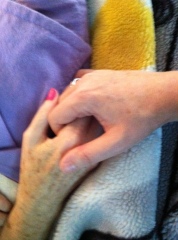
Something that has bothered me for the past nine months; was I holding her hand at the very moment she crossed over or had I let go? Now what a ridiculous thing to obsess over! Even if I knew the answer, I couldn’t change it, yet I have to consciously remind myself how illogical it is to allow that thought to take up residence in my head!
I don’t doubt some people will read this and wonder why in the world I would put myself through reliving such painful memories, but it’s not a choice. I’ll be honest; I wish I understood it. What I do know is that I watched my mother’s gradual decline for almost a decade; it’s nearly impossible to even remember her BA (before Alzheimer’s).
PTSD or Not, Caregiving Takes Its Toll
Symptoms of post-traumatic stress disorder include flashbacks, feelings of anxiety, dread, guilt, apathy, numbness, and depression, but as Dr. Jacobs points out, each of those issues are common in caregivers. It’s really up to a physician to determine whether what you’re experiencing might be a form of PTSD.
 Do I think I have it? Probably not. The thoughts and images I’ve described aren’t constantly present; they come and go. But at the end of the day we have to realize that years of witnessing the unthinkable, being forced to make life’s most troubling decisions, never being able to completely settle our racing minds, constantly facing wildly fluctuating ups and downs – all while confronting life’s “normal” daily challenges… it takes a toll.
I remind caregivers all the time they must be gentle with themselves, but the truth is, it’s still something I have to work at everyday. It’s only since my mom’s passing that I’ve realized the need extends well into life after caregiving…
I would love to hear your thoughts on caregiver PTSD, as well as how you’ve dealt with the unwelcome images and memories that come calling at the most unexpected moments.
 In recognition of World Alzheimer’s Month,
  I was recently asked to write a post for
  September 11th changed our country forever – in many mournful ways , but it’s also an excellent reminder that tomorrow is not promised. Preserve a memory, lend a hand, commit a random act of kindness – do something as a tribute to the victims of that horrific act that took place 12 years ago on a morning that started out like any other “normal” morning…
 The Long and Winding Road...